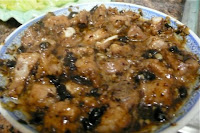
I'd prefer cooking some simple dishes during festivals so that we can remember where we came from. So I made steamed spare ribs in garlic and black beans and stir fried celery with pan fried fish patty in slices. This year I made some sticky rice dumpling as dessert. So many years ago I used to make it a lot for my grand ma.
Showing posts with label my cooking. Show all posts
Thursday, February 19, 2015
Saturday, May 12, 2012
Saturday night home cooking 咸蛋蒸肉餅 (Steamed pork patty with salty egg)
I often enjoy cooking at home during weekend in order to avoid the crowd outside. This time I thought of this steamed dish that I haven't made for over 7 years. This dish used to be my regular when I was in my high school, and it's also my father's favourite one. Over those years, I modified the recipe that my aunt taught me, with an egg to replace half portion of the 2 salty duck egg white. So this way, it's more aromatic and smoother as the salty duck egg white is a bit too rough. Another key point is to put a pinch of sea salt in it. Fresh salty and preserved salty combined is the magic touch to bring up the salty egg and pork flavour, together with some sugar to balance it. Besides, the salty egg york needs to be cut (with chopsticks) in smaller pieces so that the patty would be in a nice egg york aroma. I prefer this way rather than putting a whole egg york (it's quite a lazy way).
Sunday, August 14, 2011
My cooking - 30 minutes for a meal 薑蔥蒸鷄 蝦糕炒水通菜
When I was a kid, I got some quite tough training for cooking a meal within 30 minutes, normally 2 or 3 dishes. Why is that. 2 reasons - 1.15 lunch break at school time and the rice cooker takes about 25-30 minutes for the rice done. So in order to save time, a steamed dish over the rice is needed. This time I pick up some water morning glory and chicken.
First marinate the chicken with some sea salt and wine. Then rinse the rice and start the cooker. Cut the scallion and ginger in slices. Put some soy sauce, sesame oil. Massage the chicken a bit. Then some corn starch. Massage it. Some oil and finally put the scallion and ginger slices in it. Then put it in the rice cooker when the hot steam comes out from the rice cooker. Don't put it too early as it will make the chicken a bit too well done. This kind of steaming is quite an old time fishermen cooking style with ginger and scallion put in the steaming, instead of putting the scallion at the final stage. Actually this way the scallion may not look nice but it tastes so good, sweet too, to go with the chicken.
Prepare the veggie. Chop some garlic. Heat the wok at medium high heat, until you feel it's burning hot enough. Turn to low heat. Some oil in it. Put 3/4 garlic and some shrimp cake 蝦糕 (I prefer shrimp cake to shrimp paste, as it's more with some burnt aroma). Then immediately some very little sea salt, and if you can take it a bit spicy, put some sliced chili too. This is a nice spark for the sea salt to go with the shrimp cake and the cool oil at a heated wok. Stir it for about 5-8 seconds. Put the veggie and stir fry it as quickly as possible, until it's semi soften. Cover it with a lid until you see some steam out. Done.
*Used the 100mm F2.8 macro lens. See how the oil and the juice stay on the veggie and the scallion.

Sunday, July 31, 2011
My cooking - 猴頭菇冬菇鯊魚骨紅蘿白煲豬𦟌 Monkey head mushroom, shark's cartilage, carrot and pork soup
As far as I know my grand parents' generation that most of the old-time HK fishermen don't like catching sharks. Even after they catch the sharks, most of them would consume the other parts of the bodies, like boiling soup with the cartilage and even eating the meat or making fish ball with other fish meat. Anyway, originally I was to buy a chicken body (without wings and thighs) for my photo shooting test with my wireless flash. I supposed to take a photo with a wireless flash on the back to show the transparent chicken back bone with thin meat - like x-ray. Unfortunately when I am in the mode of cooking, I would immediately put all the freshly cut/rinsed well ingredients right in the boiling water. So the chicken was then put in the boiling water after cut and rinsed.
1. First boil the cartilage with some ginger and yellow wine for 1 minute and let it stay in the water. 2. Chicken and the pork. 3. Carrot. 4. soaked well mushrooms. 5. Dried tangerine peel and golden ham. 6. 黃(奇)白合蜜棗. No need to put much. Boil it for 2-3 hours. No need to put any salt as the golden ham brings some salty taste in it.


Thursday, June 30, 2011
My cooking: veggie, fish and soup 清炒學斗,冬菜蒸黃花魚,老樹黃瓜日月魚嚮螺豬𦟌湯
In summer time, we have to eat more lightly by getting more fish and melon/gourd. The baby bak choy 學斗 is in season now. I would prefer stir frying it with little chopped garlic and ginger. No need to put much garlic or ginger as that would spoil the nice fragrant of this baby green. 2. Yellow fish steamed with preserved veggie (冬菜). Paid HK$18 for a nice yellow fish at about 18 oz in weight. Put some ginger slices and preserved veggie and cooking oil. Then steam it at high heat for about 9 to 10 minutes. No need to put soy sauce. Eat it together with the veggie and ginger. So good. 3. This soup is good for the summer time and the dried conch and sun-moon fish (kind of a shell fish) are good for nourishing your body 滋陰 and especially good for your liver. Yellow squash is good for clearing your cumulative heat from your body. Remember to put a nice (soaked) dried tangerine peel. The meal is about HK$60 in total. Again, it depends what you get. Though the food prices are going up, if we spend wisely, we can still have a nice balanced meal. We don't necessarily eat swimming garoupa or a freshly killed chicken. I sometimes bought a plate of small fishes at HK$10. It's good for us to show it to the kids to eat more wisely and to know how to eat fish and how to take out the bones. Don't always get them frozen fish filet or some fish with less bones. The kids get to learn.


My cooking: Bitter gourd omelette 苦瓜菜脯煎蛋/Steamed abalone
1. More than half of my family members don't like bitter gourd. However, when I passed by the veggie stall and found out this seasonal bitter gourd, I had to go against the majority. In order to make them try this, I cut the gourd in very thin small slices and with some chopped preserved turnip (soaked for a few minutes to make it less salty) to make it more aromatic. First heat the pan and without any oil, to low-med. heat to slightly pan fry the gourd slices. Until it gets a bit soft (not too soft), turn off the heat and put some sugar to make the gourd a bit sweet. Then batter the egg with some sesame oil and little salt. Put the gourd and turnip in it. Then heat the pan at medium to med-low heat to pan fry whatever shape of omelette you feel like.
2. Ap Lei Chau food market is so good that we can find a wide variety of wild catch seafood. Lately we found some wild catch abalone (check on the shell if it's with some seaweed like color and in straps with some brown color. These are the wild catch ones.). Don't let the shops clean the abalone for you. Don't be lazy. Do the cleaning by yourself. So get a soft brush (e.g. soft tooth brush) to clean the outer skirt and the surface of the abalone (I also clean the shell too). No need to be very entirely clean. Just to clean those you feel a bit sticky. This way, the abalone won't get shrunk and so the meat wouldn't be too tough. So be happy with them when you clean them, like you are giving the abalone a "spa treatment". Then remember abalone is one of the few seafood need to be steamed at med-low heat for about 8-10 minutes (depending on how many and how big of the abalone), because that wouldn't make them suddenly stress up and so the meat texture would be too chewy. I would put some nice (soaked) dried tangerine peel slices for the steaming, with a final touch of some hot boiling cooking oil and sliced scallion.

Saturday, June 04, 2011
My cooking - making the better out of the not-so-healthy - instant noodle
I don't like instant noodle at all, but still keep a few packs in case I feel like some noodle soup sometimes. Would like to share how to reduce something not good from instant noodle while enjoying it. The key point is to make a half portion of hot water for the soup powder mix first while having the pot boiling water. After the water is boiled, put some sea salt (about 1 teaspoon). Sea salt has a magical effect on breaking the grease in the noodle (or some kind of wax on it). Then use a pair of chopsticks to soak the noodle until it's soft and try to loosen the noodle. This way the noodle would be evenly cooked. Then stir the noodle in the water a bit. Let it boil for a short while (up to your preference). By now, you would notice a layer of grease in the water. Drain it well and put the cooked noodle in the soup. Stir a bit and pour in another half portion of cool (boiled) water or room temperature water. This way, the noodle would be a bit al-dente. I don't drink the soup as the noodle already absorbed some of the soup. Just one more step but we can eat a bit healthier from not taking all the grease of the instant noodle.


Wednesday, June 01, 2011
My cooking - dealing in inflation with HK$30
To fight against the inflation, let's get more creative in our home cooking.
I paid HK$2 for a half cut (about 3/4 catty) radish, another $2 for pasley, $4 for 2 preserved thousand year eggs 皮蛋, $10 fish patty 鯪魚肉. $18 for a soup with fish and veggie, good for 3-4 people. Then I got $10 ground pork and $2 preserved veggie 梅菜. One more dish at $12. Total $30.
Can't afford a bigger fish patty? Try to put some ingredients like chopped radish or carrot in it (I made it as 1 (radish) to 3 (fish patty) portion. Stir it well to make it sticky enough. Put some chopped parsley if you like it, and cornstarch to make it a little thicker. Cut the remaining radish in thick slices and put it in a pot with cool water. Put a thick cut (0.3 to 0.5 inch) ginger and crush or crack it (when the water is cool too *this way the ginger won't have the "hot" character in the soup). Just water is good to have the natural sweet from fresh radish. Then dice the preserved duck egg, and cut the (rinsed well) parsley in about 1 to 2 inches long (up to your preference). Put the fish patty with a spoon to break in pieces when the water is boiled, then followed with the diced duck egg. Boil it for a few minutes after the fish patty floated up. Some salt to your taste. Some pepper powder if you like and a few drops of sesame oil. Finally it's the parsley and turn off the heat immediately. Take out the fish patty and other ingredients and serve it as a plate (dip with soy sauce if needed). Re the 2nd dish, I think I have mentioned this one before. This dish is very good to go with steamed rice. So $30 for a soup and 2 dishes. Good for 3-4 people.

I paid HK$2 for a half cut (about 3/4 catty) radish, another $2 for pasley, $4 for 2 preserved thousand year eggs 皮蛋, $10 fish patty 鯪魚肉. $18 for a soup with fish and veggie, good for 3-4 people. Then I got $10 ground pork and $2 preserved veggie 梅菜. One more dish at $12. Total $30.
Can't afford a bigger fish patty? Try to put some ingredients like chopped radish or carrot in it (I made it as 1 (radish) to 3 (fish patty) portion. Stir it well to make it sticky enough. Put some chopped parsley if you like it, and cornstarch to make it a little thicker. Cut the remaining radish in thick slices and put it in a pot with cool water. Put a thick cut (0.3 to 0.5 inch) ginger and crush or crack it (when the water is cool too *this way the ginger won't have the "hot" character in the soup). Just water is good to have the natural sweet from fresh radish. Then dice the preserved duck egg, and cut the (rinsed well) parsley in about 1 to 2 inches long (up to your preference). Put the fish patty with a spoon to break in pieces when the water is boiled, then followed with the diced duck egg. Boil it for a few minutes after the fish patty floated up. Some salt to your taste. Some pepper powder if you like and a few drops of sesame oil. Finally it's the parsley and turn off the heat immediately. Take out the fish patty and other ingredients and serve it as a plate (dip with soy sauce if needed). Re the 2nd dish, I think I have mentioned this one before. This dish is very good to go with steamed rice. So $30 for a soup and 2 dishes. Good for 3-4 people.

Saturday, May 14, 2011
My cooking - Stir fried green amaranth 炒莧菜 and stewed mushroom chicken 冬菇雞
Last month when I walked with my aunt, just like the old time when I walked with her for the strolling at dusk, we somehow talked about some old Chinese saying. It's very warm hearted when she and I still recall about how we call amaranth 莧菜 as the veggie to be "餓死新袍 嚇死奶奶" (Getting the daughter-in-law starve to die, getting the mother-in-law scared to death). It's because amaranth can shrink so much, almost double as compared to other veggie, after it's cooked. So the old story was that a mother-in-law gave some money to her daughter-in-law for buying food for the dinner. Normally the mother-in-law would have a list for what to get, say one catty veggie, half catty pork...etc. The daughter-in-law bought one catty of this veggie. After it's cooked and served on the table, the mother-in-law got shocked why one catty could be that small. So either it would upset the mother-in-law or the daughter-in-law needs to get on diet from letting the others eat more.
1. To cook this kind of watery veggie, draining the water is an important step. I often swing the veggie in my hands like those Japanese chefs swing the noodle before getting them in the bowl. Gotta be a powerful swing. Or you get a spinner to make it simple. Somehow I prefer some hand work. It's a good exercise though. Then heat the wok (use a big wok, better not those non-sticky shallow wok) with some cool oil. Toss the veggie to let some air in, with some salt, sugar and a few drops of rice wine or yellow wine on your preference. When it's a bit soft, cover it and cook until some steam is out. This way the veggie wouldn't get yellow.
2. I guess I have posted about this cooking before. Check on the label for my cooking. The key point is to get a fresh chicken, fresh carrot (better those with some mud on as it has very strong carrot aroma) and some nice dried mushroom (avoid those with dark wet part. Smell it if possible, to make sure it's not with some wet sour aroma).
Again, during the process of cooking, I gotta learn how it can apply to our daily life and even to my work - timing, judgement and discerning. After all, the food soothes our mind.

Monday, March 21, 2011
My cooking - 去濕水 detoxifying sweet soup


Posted a few days ago on my home made UFO. I went to the market for getting some winter melon (I guess it's imported from Thailand since it's not the season here) and a pack of the Chinese herbs for making this soup to clear up the accumulated unwanted elements in my body, especially eating some heavy seafood and meat or fruits/veggie, like mango, eggplant and pumpkin...etc.
1. the ingredients - top left is the lotus pouch that I played it as UFO, but this one is a bit pressed.
2. Winter melon. Normally I would get one Chinese catty (about 22 ounces or 0.625 kilo.). Rinse everything well. Put the ingredients except the melon and beans in a "soup boiling" bag. Then put that bag and winter melon in the pot when the water is cool. When it gets to boil, put the beans and barley (this way it can avoid the beans and barley getting sticky on the pot's bottom and therefore got burnt. Then boil it at low heat for 1.5 to 2 hours. Take out the bag. Put some cane sugar bar to taste. BTW, cane sugar bar is good for clearing up the toxic stuff in our body. If you suspect you have a slight food poisoning or having some skin allergy, drink some hot water with cane sugar bar melt in it.
3. Done. Eat the melon and beans too if possible. *remarks you would feel like having more water out of your body after taking this soup and that's normal.
Saturday, January 22, 2011
Cliff in my house & family treasure
This classic Chinese wooden cutting board had been the latest one with me. It has retired about 12 years ago when I got the so-called "anti-bacteria" plastic cutting board. All I can tell you, no matter what xxx, nami, anti-bacteria material cutting board, wooden board is still the best. It goes well with sliding, chopping, cutting, crushing force. The key point to keep a good wooden board is to boil it in the wok with hot water for a few minutes so that the dirt inside the wood would come out. Do this boiling every month or every few months (depending on the seasonal warmth and humidity). No need to have anything fancy to clean it since wood is the most natural thing.


Tuesday, January 11, 2011
Tribute to Madam Lee Tsang Pang Chin 李曾鵬展女士
Last time when I had a dinner with my sister, we ordered a stir fried baby spinach 豆苗. That dish came out very watery without any veggie flavour. All of a sudden, my sister complimented me "you did this much better. At least no water on the plate...". Didn't mean to "hard sell" my technique but the truth is "I forget I did this right since I haven't done it for a long long time.". I even forgot I killed a big live fish which is bigger than my arm's length. I killed a live quail too. So many things I forgot. Now I could just comment this or that, and be picky. Anyway, it's now the season for baby spinach and we can even find the junior baby spinach 豆杯.
There is a cooking genuine lady I need to thank her back in time. She is Madam Lee Tsang Pang Chin. I learned from her about quick stir-frying veggie. Anyway, I tried this lately and glad that I could still keep up with what she told. The fundamental points are:
-when rinsing the baby spinach, do it gently in the water by not squeezing the leaves.
-spinning the water out of the baby spinach. Better swing the veggie in your palm (like how the Japanese chef swing the noodle to drain the water).
-not to put the veggie tightly together. Better with some air among them.
-Let the veggie drain the water out by waving the drainer in various angle.
-Put the salt/sugar/wine on the veggie. Right away put the veggie on the wok with cool oil and hot burnt wok.
-Never use non-sticky wok. Better use a big round Chinese wok.
-After putting the veggie, don't press them and don't stir them. Toss them in the wok.
-When the veggie is semi-softened, cover the lid for about 30 seconds, or until some steam coming out.
-Put that on the plate immediately.
*practise this more until you don't find any much water left on the plate. Stir frying veggie quickly would seal the juice and vitamins of the veggie better. If it's too watery, the vitamin and minerals would be lost in the water.
Sunday, December 19, 2010
My cooking - 咸鮮青根魚, salty fresh fish
Passed by the market today and wanted to get the 鮫魚 for making my family's traditional fish ball, but then this nice fish caught my eyes! Now it's the season for this fish and as I checked on how clear deep blue of the eyes and the nice light pink color (most of this fish is quite aqua green and that's why it's called "青根", I got it right away. The best for making this fish is to use raw sea salt to marinate it (just cover it well inside out) for a few hours but need to put it in the fridge, or overnight (but if overnight, then use less salt). So rinse it well, esp. the blood vein in the tummy and inside the head. Dry it. Slice some ginger and put some oil (better more oil - about 2 to 2.5 soup spoons for this size (about 10 oz). I usually steam it in the rice cooker when the rice is being cooked since the rice steam will make it even aromatic. Or steam it in a wok for 8-10 minutes (depending on how cold the fish body) at medium high heat.
*the below photo is on Canon 70-200mm F4 at 131mm, 1/160, F6.3, ISO 400 with flash 1/32 90 degree straight upward, with some 5pm sunlight coming in from window on the top right direction. As you can see the fin, it's really amazing with this lens. Never thought I could take a photo of this fish (my father's and grand ma's favourite).
Wednesday, November 17, 2010
My cooking - 参鬚蜜棗茶 Ginseng's root date drink
In the early stage of my Bangkok trips, Yaowara was a must for every night supper. I went in the Eastern bird's nest shop. Before any order, I was given a bowl of ginseng's root tea (not sure about the exact English term) Felt so good after a day of walking and eating heavily. This is a very good tactic for getting customers relax and of course good for selling their bird's nest dessert. Since then, this ginseng's root drink has been deep in my mind. Every now and then, I would make this drink to refresh myself. I would add some date and rock sugar to make it a bit sweeter. Good for enhancing your respiratory system (提氣). The date is to balance the little hot nature of ginseng. That's one of the few things in Bangkok I got inspired.

Monday, May 17, 2010
My Cooking - red mullet, tomato potato soup 蕃茄著仔紅衫魚湯
1. Cut the bones out the spare ribs' for the soup, and left the meat for another steamed dish. Diced potato. 2. Tomato and onion. Pan fried potato, ribs and onion. Put them for boiling water with some ginger.

3. Spent quite some time in getting some fresher red mullet but I wasn't satisfied. So I put more ginger slices in the tummy. Supposed Chinese wok is better for pan frying fish. See the sides weren't in contact of the heat. Oops. My grand mom would blame me on placing the 2 fishes head to head and tail to tail. Better head to tail as it means a round and round it goes. Then put the fish in the soup for boiling for about 10 to 15 minutes. 4. Done! I used a bit too much of tomato; so it's a bit thick. 55 marks out of 100. Major fault on the fish not too fresh. Miss Shaukiwan a lot!

3. Spent quite some time in getting some fresher red mullet but I wasn't satisfied. So I put more ginger slices in the tummy. Supposed Chinese wok is better for pan frying fish. See the sides weren't in contact of the heat. Oops. My grand mom would blame me on placing the 2 fishes head to head and tail to tail. Better head to tail as it means a round and round it goes. Then put the fish in the soup for boiling for about 10 to 15 minutes. 4. Done! I used a bit too much of tomato; so it's a bit thick. 55 marks out of 100. Major fault on the fish not too fresh. Miss Shaukiwan a lot!
Sunday, May 09, 2010
My cooking - Khao Mun Gai (chicken rice)
Hainanese chicken rice was my most favourite but now I can't take it too much due to the greasiness. It's really a love and hate thing. So alternately I made a healthier one but the reality is poultry fat can never be replaced. :) Besides, charcoal boiling is another essential factor.


1. OK, home cooking is home cooking. Let's lower our demand. First heat the wok with some cooking oil (supposed to use the chicken fat or at least peanut oil), but I used olive oil. Put some garlic gloves and ginger slices. The garlic glove shouldn't be peeled and slightly crush it to crack a bit, so for the ginger slice (needs to be a bit thicker slices). 2. Use some pre-washed rice. Best to use Golden Elephant pre-washed rice (with vitamin B-complex added). Don't wash it, as the moist in the rice after washing would get sticky on the wok. Pan fry the rice a bit. Then put that in the rice cooker and pour in chicken broth for cooking.

3. I would give it only 40 marks out of 100, because (1. I used olive oil (or suggest rice bran oil). 2. Should have bought some fresher garlic. 3. I didn't use Golden Elephant rice. 4. I didn't use charcoal boiling.). So where is the chicken? I didn't make it since I didn't have enough time to go to Shaukiwan for buying a nice and lively killed Long Kong 龍崗 chicken. Instead, I just went to buy an already made chicken from the BBQ shop. OK, the classic cooking for the chicken is to dip the chicken in hot boiling water (with some ginger/scallion) for 10 to 20 seconds. Then take it out and dip it in room temperature water (not tap water; should be boiled first). So this process should take almost 40 minutes to an hour depending on the size of the chicken and your testing to the inside of the chicken. This hot and cold process is to maintain the tenderness and sealing of the original flavour of the chicken. Another alternate easier way is to have a big wok and the boiling water is high enough to cover the whole chicken. Put some ginger and scallion in the water. Rub the chicken inside out with some raw sea salt. So put the chicken in the high heat boiling water of the wok. Then turn off the heat and let the chicken soak in the wok. Remarks: the chicken should be a lively killed one and don't put it in the fridge. You should do it right after you get it. Don't let it stand for more than an hour. So that's why in the old days we went to the market twice, or even 3 times a day! :) The above soaking chicken cooking is a tribute to my aunt who told me that. Salute! She is now over 80 years old and still eats a lot of choy sum and fresh fish!

3. I would give it only 40 marks out of 100, because (1. I used olive oil (or suggest rice bran oil). 2. Should have bought some fresher garlic. 3. I didn't use Golden Elephant rice. 4. I didn't use charcoal boiling.). So where is the chicken? I didn't make it since I didn't have enough time to go to Shaukiwan for buying a nice and lively killed Long Kong 龍崗 chicken. Instead, I just went to buy an already made chicken from the BBQ shop. OK, the classic cooking for the chicken is to dip the chicken in hot boiling water (with some ginger/scallion) for 10 to 20 seconds. Then take it out and dip it in room temperature water (not tap water; should be boiled first). So this process should take almost 40 minutes to an hour depending on the size of the chicken and your testing to the inside of the chicken. This hot and cold process is to maintain the tenderness and sealing of the original flavour of the chicken. Another alternate easier way is to have a big wok and the boiling water is high enough to cover the whole chicken. Put some ginger and scallion in the water. Rub the chicken inside out with some raw sea salt. So put the chicken in the high heat boiling water of the wok. Then turn off the heat and let the chicken soak in the wok. Remarks: the chicken should be a lively killed one and don't put it in the fridge. You should do it right after you get it. Don't let it stand for more than an hour. So that's why in the old days we went to the market twice, or even 3 times a day! :) The above soaking chicken cooking is a tribute to my aunt who told me that. Salute! She is now over 80 years old and still eats a lot of choy sum and fresh fish!
Monday, May 03, 2010
My Cooking - economy dishes 家常便飯
Wanna have 3 dishes for 3-4 persons at HK$30? OK, let's go buy some spare ribs at HK$15-18, 2-3 pieces of tofu at around $4-6, 1 catty of veggie at HK$4-6.

1. Tofu panfried with shrimp paste and pork fat. When you buy the spare ribs, cut out the fat parts from the ribs and use it for pan frying of the tofu. I would first chop the fat with some raw sea salt to make the burning more aromatic. Also with some chopped garlic. After the tofu get brown, put the shrimp paste and burn it a bit. Then put some water and little sugar to make it taste. If you prefer it more salty, put some soy sauce. I personally don't prefer using soy sauce as I like the light shrimp taste. 2. Put black beans, chopped garlic, chili if you can take it or very little chopped ginger if you can't take chili., soy sauce, sugar, sesame oil, very little oyster sauce, cornstarch and little oil. Put it inside the rice cooker for steaming. The rice aromatic steam makes it very nice. Besides, it's more energy saving. Then you just concentrate cooking the tofu and stir fried veggie. I would let the tofu pan fried while rinsing the veggie. 3. This time, I bought lettuce and stir fried it with sea salt and ginger/garlic. Suggest to choose a lighter taste of veggie and not deep green veggie so as to balance the heavy taste of the other 2. Besides, deep green veggie would have certain chemical reaction with tofu, and not good for digestion.
Wednesday, April 21, 2010
My cooking - green bean sweet with fragrant grass 臭草綠荳沙
Passed by the market and there came a very nice fragrance of this green green grass. Time for a green bean sweet and it's good to clear up those accumulated hot wet from eating too much in the winter time.

1. At a portion of 3-4 litre of green bean sweet, use only 2 branches of it, leaving the rest as a room fragrance if you like it. Too much of this would be a bit too bitter. 2. Cooking this one is not like cooking red bean sweet. Use only 1/2 portion or not more than 3/5 of the red bean portion for the same amount of water. Green bean can be quite swelling; so it had better not be too much. Put one soup spoon of rice to make it in more texture. I would put the fragrant grass together with the beans when the water is boiling, but leave a small amount of younger leaves (maybe 1/10th). Boil for 1.5 hour something to 2 hours. Then put the younger leaves and boil for 10 minutes and put cane bar sugar to sweet. This way the fragrance would be at more levels - a bit subtly burnt and a bit fresh.
Subscribe to:
Posts (Atom)